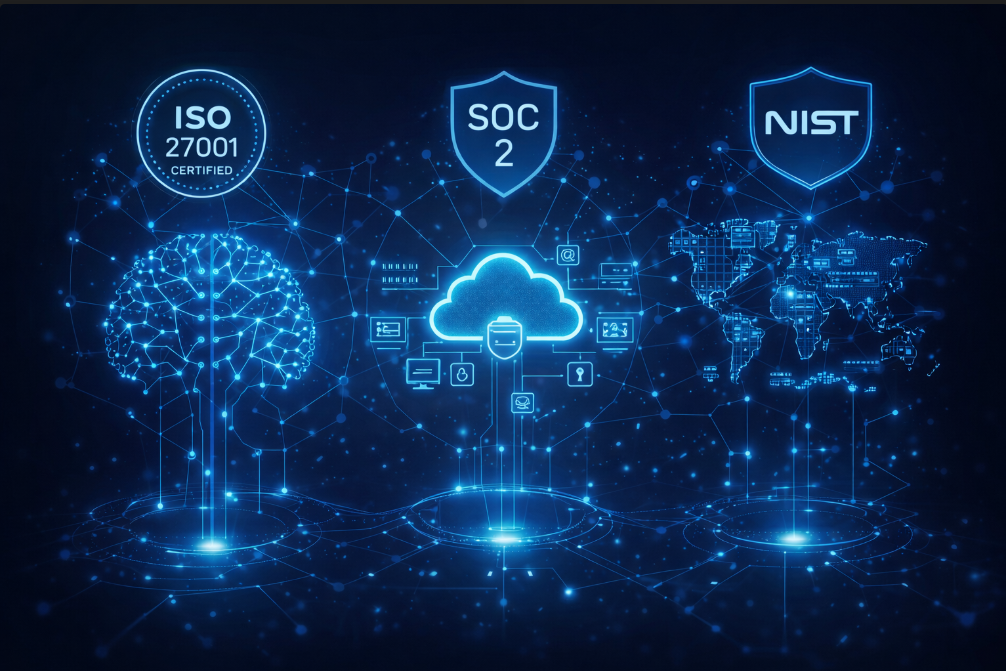
- AI Governance Is Now a GRC Function : The regulatory shift and what it demands from practitioners.
- Cloud Compliance Is the New Core Competency : Why SOC 2 fluency is becoming baseline, not advanced.
- Third-Party Risk Is the #1 Attack Vector : The supply chain crisis and the TPRM response.
- What This Means for GRC Professionals : The emerging skill profile of the modern GRC analyst.
- How to Position Yourself : Specific investments with the highest return.
The Governance, Risk & Compliance function has a well-earned reputation for stability. Frameworks change slowly. Audit cycles are predictable. The core disciplines; risk assessment, control mapping, compliance documentation - have remained recognizable for decades.
That stability is dissolving.
Three converging forces are compressing what would normally be a decade of evolution into a 2 to 3 year window: the emergence of AI governance as a formal compliance discipline, the maturation of cloud-native architectures that require fundamentally different compliance approaches, and the escalation of third-party and supply chain risk as the dominant breach vector against enterprise organizations.
Together, these trends are not merely adding responsibilities to the GRC function. They are redefining what GRC practitioners are expected to know, what they are expected to produce, and what constitutes competitive competency in the hiring market.
This article examines each trend in detail, draws on both industry data and direct practitioner experience, and offers a clear framework for how GRC professionals can position themselves ahead of the shift.
AI Governance Is Now a GRC Function
In 2023, most compliance teams were still debating whether AI governance was a legal problem or a technology problem. By 2025, the answer is unambiguous: it is a GRC problem.
The regulatory environment has moved from advisory to binding. The EU AI Act (entering enforcement in phased stages) created formal compliance obligations for organizations deploying high-risk AI systems in European markets. ISO/IEC 42001:2023 established the international standard for AI Management Systems, providing the audit-ready framework that ISO 27001 provides for information security. NIST released its AI Risk Management Framework in early 2023, which has since become the most referenced voluntary standard for AI governance in US-regulated industries.
The practical consequence for GRC teams is significant. Practitioners are now being asked to:
- Conduct formal risk assessments for AI vendors and internally deployed models.
- Establish audit trails for AI-generated decisions in regulated contexts.
- Evaluate AI model transparency and explainability as compliance controls.
- Assess AI bias and fairness against emerging regulatory definitions.
- Integrate AI-specific questionnaire domains into existing TPRM programs.
In my own experience managing vendor risk assessments, AI vendor evaluation criteria were already being integrated into formal procurement reviews. The questions had shifted from "is this vendor's security posture adequate?" to "can we audit the decisions this AI system is making, and does the vendor's model governance documentation meet our regulatory requirements?"
"The GRC professionals who develop AI governance fluency now will occupy a high-value, low-supply position in the talent market for the next 3-5 years. The window to be early is open, but narrowing."
| Framework | Type | Jurisdiction | GRC Relevance | Status |
|---|---|---|---|---|
| EU AI Act | Regulation | European Union | Binding compliance obligations for high-risk AI systems | Enforcement Active |
| ISO/IEC 42001:2023 | International Standard | Global | Auditable AI Management System (AIMS) : (Certifiable) | Published & Active |
| NIST AI RMF | Framework | United States | Voluntary risk management standard; widely adopted | Widely Adopted |
| UK AI Pro-Innovation Framework | Policy | United Kingdom | Principles-based approach; sector regulators apply | Evolving |
| Canada AIDA | Proposed Legislation | Canada | Artificial Intelligence and Data Act | In Development |

When SOC 2 was first defined, most enterprises ran on-premise infrastructure. Compliance was about auditing binders of policies and reviewing access logs from physical servers. The paradigm was static and cyclical; annual audit, annual assessment, annual review.
Today, the average enterprise operates across three or more cloud providers, uses 200+ SaaS applications, and deploys infrastructure via code that can change hundreds of times daily. The compliance paradigm that worked for on-premise environments is structurally incompatible with this reality.
The implications for GRC practitioners are structural, not incremental. Cloud compliance requires a fundamentally different skill set:
- Infrastructure-as-Code review is becoming a standard audit procedure. GRC analysts need to understand what a Terraform file or CloudFormation template is, and what compliance risks it introduces.
- Cloud Security Posture Management (CSPM) tools - AWS Security Hub, Microsoft Defender for Cloud, Wiz - are generating the evidence that feeds compliance reports; practitioners must be able to interpret and contextualize that output.
- Continuous compliance monitoring is replacing point-in-time audits for organizations with mature security programs; the ability to design and maintain a continuous monitoring program is a differentiating skill.
- Evidence collection at scale has changed from a pre-audit scramble to an automated, ongoing practice in leading compliance programs.
In completing the SOC 2 cloud control mapping project within my portfolio series, a consistent finding emerged that mirrors what practitioners see in production environments: most cloud environments are already 60–70% of the way to SOC 2 compliance. The technical controls exist. IAM is configured. CloudTrail is running. S3 buckets are encrypted.
The gap is almost entirely documentation. Controls are not formally linked to Trust Service Criteria. Evidence is not organized for audit consumption. Configuration changes are not tracked in a compliance context.
"Cloud compliance is not an architecture problem. It is a documentation, evidence management, and continuous monitoring problem and those are GRC skills, not engineering skills."
Third-Party Risk Is the #1 Attack Vector
The data tells a consistent story: in the current threat environment, the most reliable path to compromising an enterprise organization is not to attack it directly. It is to find a vendor, supplier, or partner in its ecosystem with weaker controls and use that relationship as a bridge.
The 2020 SolarWinds compromise. The 2021 Kaseya attack. The 2023 MOVEit breach. The 2024 Snowflake credential theft campaign. Each of these incidents, affecting hundreds to thousands of downstream organizations, entered through a trusted third-party relationship.
The GRC response to this pattern has been the formalization of Third-Party Risk Management (TPRM) as a distinct discipline within compliance programs with its own staffing, tooling, and reporting structures. Where TPRM once meant sending a questionnaire to major vendors annually, modern programs include:
- Continuous vendor security rating monitoring via platforms like SecurityScorecard, BitSight, or Panorays.
- Tiered risk classification based on vendor criticality, data access level, and integration depth.
- Contractual security requirements embedded in vendor agreements and enforced at renewal.
- AI vendor-specific assessment domains covering model transparency, data handling, regulatory compliance, and explainability.
- Fourth-party risk visibility : understanding what vendors your vendors rely on.
The TPRM function represents one of the clearest market opportunities for GRC professionals in 2025-2026. Organizations that previously had no formal vendor risk program are building dedicated teams in direct response to regulatory mandates (DORA, NIS2, SEC cyber disclosure rules) and high-profile third-party breach incidents.
"Your vendor list is your attack surface. The GRC professionals who understand how to assess, tier, and monitor that surface are among the most sought-after practitioners in the field right now."
What This Means for the Modern GRC Practitioner
The convergence of these three trends is producing a new professional profile in GRC, one that does not yet have a widely accepted title but is increasingly recognizable in hiring conversations.
The traditional GRC analyst was primarily a compliance administrator: framework-aligned, process-oriented, audit-focused. That practitioner remains valuable. But the ceiling for that profile is declining as the function expands.
The emerging GRC practitioner profile requires four capabilities operating in combination:
- Framework fluency : ISO 27001, NIST CSF, SOC 2, HIPAA, and now ISO/IEC 42001 and NIST AI RMF. Not surface-level familiarity, but working knowledge sufficient to map controls, identify gaps, and produce audit artifacts.
- Technical literacy : Sufficient understanding of cloud configurations, SIEM telemetry, and AI system architectures to assess controls without being dependent on engineering to interpret findings.
- Evidence discipline : The operational habit of documenting, organizing, and maintaining compliance artifacts as a continuous practice, not a pre-audit event.
- Business communication : The ability to translate risk findings and compliance status into language that is immediately actionable for executives, boards, and non-technical stakeholders.
These four capabilities are not equally distributed in the current talent pool. Practitioners with all four - particularly those with demonstrable fluency in AI governance and cloud compliance - represent a supply-demand imbalance that currently favors the practitioner significantly.
How to Position Yourself: Five Investments with the Highest Return
Conclusion: The Convergence Is Already Underway
The GRC analyst of 2026 is not the GRC analyst of 2020. The function has expanded from compliance administration to risk intelligence, from annual audit cycles to continuous monitoring, from point-in-time vendor reviews to ongoing supply chain risk management, and from information security governance to AI governance as a parallel and growing discipline.
The practitioners who thrive in this environment will be those who treat GRC as what it increasingly is: a dynamic, technical, and strategically consequential function and not a documentation exercise.
The convergence is already underway. The organizations building AI governance programs, maturing their cloud compliance postures, and investing in formal TPRM capabilities are not planning for a future state. They are responding to current regulatory obligations, current breach patterns, and current board-level risk expectations.
The question for GRC professionals is not whether to adapt. The question is how quickly the adaptation begins.